




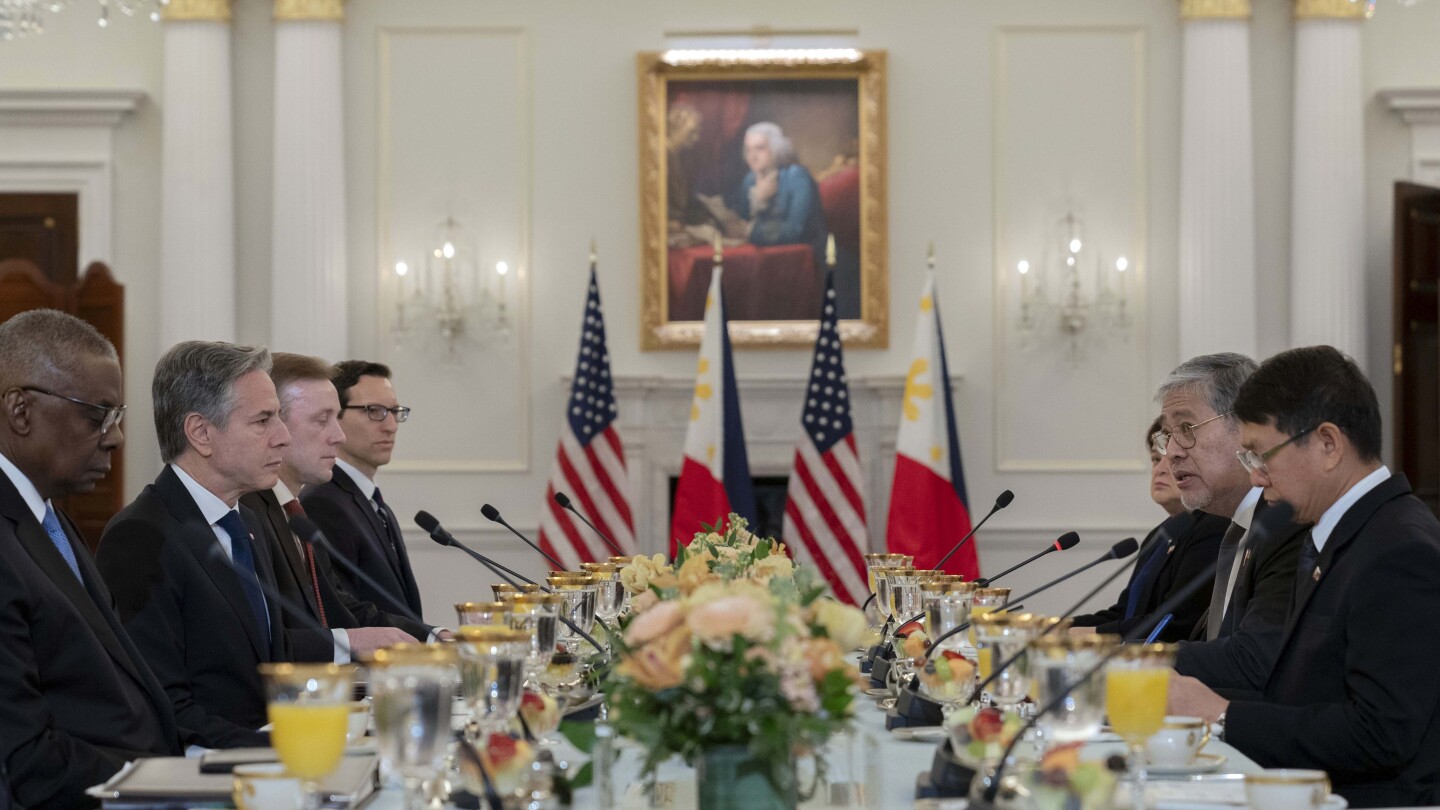
The Biden administration has reaffirmed its commitment to the Philippines in the face of increasing tensions with China in the South China Sea. Following a trilateral summit involving the U.S., Japan, and the Philippines, officials from both countries met to discuss strategic and military issues. Secretary of State Antony Blinken emphasized the importance of a free and open Indo-Pacific and reiterated the U.S.’s defense commitments to the Philippines under the Mutual Defense Treaty. The meeting also addressed recent Chinese provocations in the South China Sea, with both sides expressing determination to assert their sovereign rights in the region.
Defense Secretary Lloyd Austin met with Philippine President Ferdinand Marcos Jr. at the Pentagon to discuss ways to enhance military cooperation, including increasing joint patrols in the South China Sea. Austin highlighted the Pentagon’s budget request for 2025, which includes funding for projects at Enhanced Defense Cooperation Agreement sites to strengthen defense capabilities. Marcos emphasized the importance of the agreements reached during the summit in ensuring safety, peace, and stability in the South China Sea, a region plagued by ongoing disputes and tensions.
During the summit, President Biden reiterated the U.S.’s ironclad commitment to its Pacific allies, including the Philippines and Japan. He emphasized that any attack on Philippine aircraft, vessels, or armed forces in the South China Sea would trigger the mutual defense treaty between the U.S. and the Philippines. The summit was seen as a strong response to China’s attempts at intimidation in the region and aimed to send a clear message that China’s actions were viewed as unacceptable by the U.S. and its allies.
Tensions between China and the Philippines have been fueled by repeated confrontations in the South China Sea, including incidents involving coast guard vessels from both countries. China’s gray-zone harassment tactics have included shining military-grade lasers at the Philippine Coast Guard, firing water cannons, and ramming into Philippine ships near disputed areas. Chinese officials have defended their actions as lawful and justified, accusing the U.S. and other countries of exacerbating tensions in the region. The ongoing disagreements highlight the complex geopolitical dynamics at play in the South China Sea.
President Biden has prioritized improving relations with the Philippines since President Ferdinand Marcos Jr. took office in June 2022. The relationship between the two countries has faced challenges in the past, particularly under former President Rodrigo Duterte, whose controversial war on drugs led to human rights abuses. Despite initial indications of pursuing closer ties with China, Marcos has shifted towards closer alignment with the U.S. amid concerns about China’s aggressive behavior in the region. The U.S. continues to support the Philippines in asserting its sovereign rights and protecting regional security in the face of Chinese provocations.
As tensions continue to escalate in the South China Sea, the trilateral cooperation between the U.S., Japan, and the Philippines serves as a critical bulwark against Chinese aggression. While China remains defiant in asserting its territorial claims and justifying its actions in the region, the U.S. and its allies are determined to uphold international norms and principles. The ongoing dialogues and military cooperation between the U.S. and the Philippines underscore the shared commitment to a free and open Indo-Pacific, where countries can exercise their rights without fear of coercion or intimidation.