




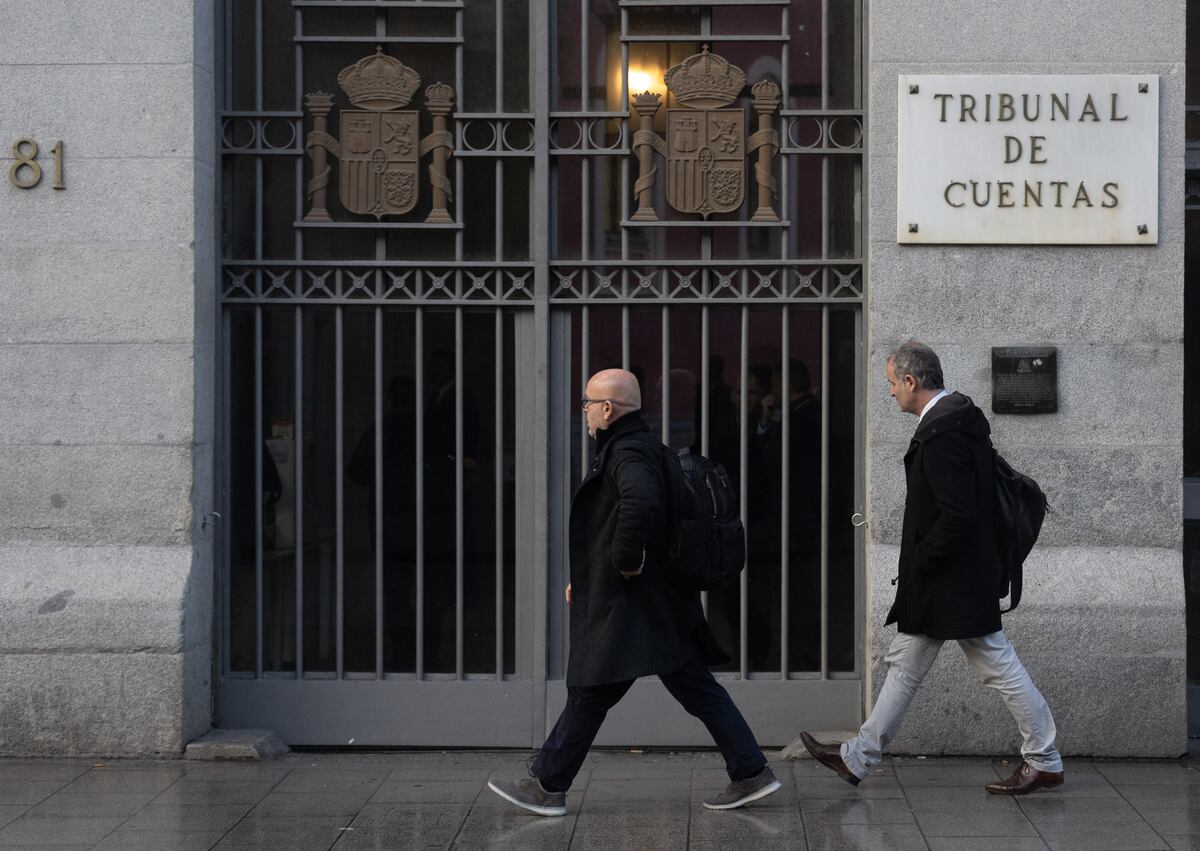
The Court of Auditors has decided not to apply the amnesty to the main leaders of the Catalan independence movement for the time being, as it believes that they diverted funds for “purposes prohibited by law” and thereby harmed the financial interests of the European Union. In a 56-page ruling sent to the Court of Justice of the European Union on Monday, the Court of Auditors requested a preliminary ruling on the legality of the amnesty law and asked for guidance on how to proceed. The Court of Auditors conducted a trial for embezzlement against former Catalan presidents Carles Puigdemont and Artur Mas, former vice president Oriol Junqueras, and 32 other former high-ranking officials of the Catalan government in late 2023, making it the first judicial body to challenge the amnesty law at the European level.
The Court of Auditors, led by the appointed counselor Elena Hernáez from the Popular Party, has suspended the issuance of the sentence and maintained the precautionary measures taken against the defendants, who provided a guarantee from the Catalan Institute of Finance to prevent the seizure of their assets. The institution is seeking the interpretation of several European regulations in this case, including Regulation 2988/95 on the protection of EU financial interests, Article 325 of the Treaty on the Functioning of the European Union on combating fraud and illegal activities affecting EU financial interests, and Article 4.3 of the TFEU (principle of loyal cooperation). The Court of Auditors argues that these regulations are not compatible with the “extinguishing of liability” established in the amnesty law, especially considering the impact of the events related to the Catalan independence movement on the EU’s financial interests.
The Supreme Court also recently took action to prevent the application of the amnesty law to the leaders of the Catalan independence movement. It filed a constitutional challenge, describing the law as “arbitrary,” “discriminatory,” and contrary to the principle of equality. In a unanimous ruling, the Supreme Court referred its concerns about the amnesty law to the Constitutional Court, expressing its belief that the law violates the Constitution and for the first time, labeling the Catalan independence movement as a “coup d’état” and its leaders as “coup plotters.” The implications of these legal challenges and the classification of the events as a coup d’état have significant implications for the political landscape and rule of law in Catalonia and Spain.
The legal battles surrounding the amnesty law and its application to the leaders of the Catalan independence movement reveal the complexities of navigating the intersection between national and European legal frameworks. The involvement of the Court of Auditors and the Supreme Court in challenging the legality of the law reflects the broader debate over accountability and the protection of EU financial interests in the context of political movements like the Catalan independence movement. The European Union’s principles of financial integrity and cooperation among member states are being tested by these legal disputes, highlighting the challenges of balancing regional autonomy with EU legal standards.
In conclusion, the Court of Auditors and the Supreme Court’s actions demonstrate the complexities and tensions arising from the application of the amnesty law to the leaders of the Catalan independence movement. The legal challenges and consultations with European institutions underscore the importance of upholding the rule of law and accountability, particularly in cases where the financial interests of the EU are at stake. The outcome of these legal battles will have significant implications for the future of the Catalan independence movement, as well as for the broader political and legal landscape in Catalonia and Spain. The resolution of these issues will shape the relationship between regional autonomy and EU legal standards, highlighting the ongoing debate over sovereignty, accountability, and the rule of law in the European context.