




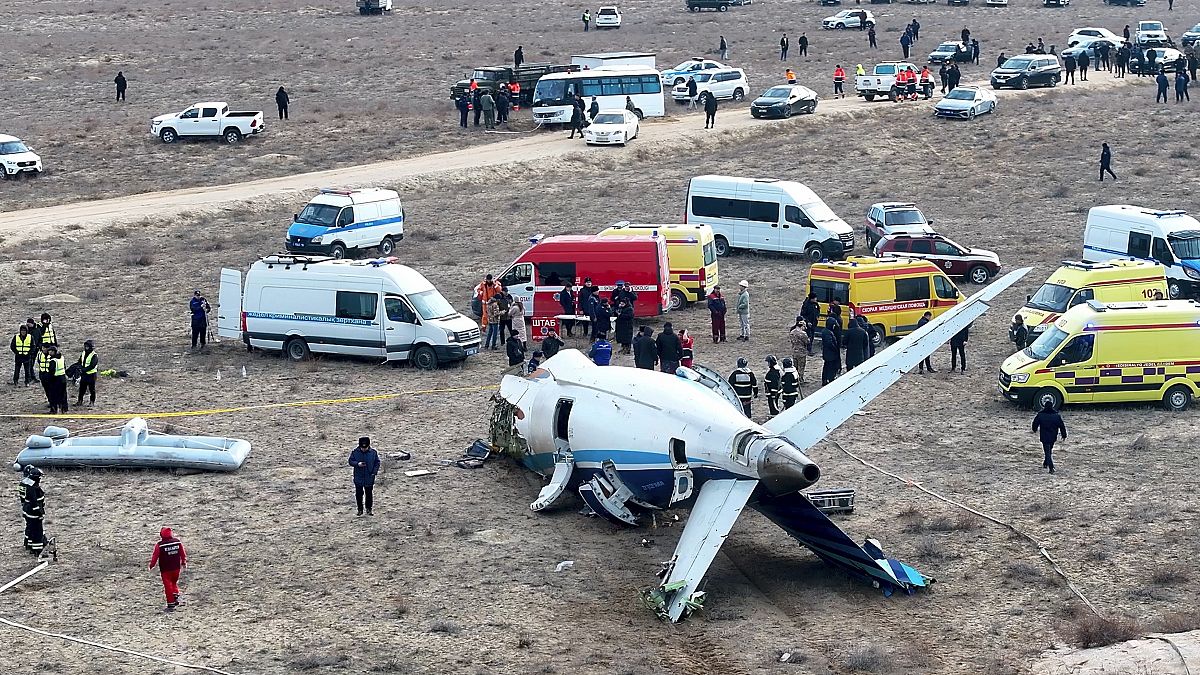
A Russian military expert has suggested that the Azerbaijan Airlines flight that crashed in Kazakhstan was likely brought down by an anti-aircraft missile. The flight took off from Baku and was headed for Grozny in Chechnya when it crashed in Aktau. Azerbaijani government sources exclusively confirmed that a Russian surface-to-air missile caused the crash. The expert, Yan Matveyev, mentioned that the tail section of the plane seemed to have been damaged by missile fragments, possibly from a Pantsir S-1 missile or a similar anti-aircraft system. He also noted that Ukrainian drones were flying over Chechnya at the time of the crash, suggesting a possible attack by Russia’s air defenses.
Despite requests for an emergency landing, the damaged aircraft was not allowed to land at any Russian airports and was directed to fly across the Caspian Sea to Kazakhstan. Data reveals that the plane’s GPS navigation systems were jammed during the flight over the sea. The investigation into the crash is ongoing, and Moscow has urged against speculation until the probe is complete. The Kremlin spokesperson emphasized the need to wait for the investigation’s conclusion before drawing any conclusions. It is expected that the investigation will reveal why Russia denied the aircraft permission to land at its airports, forcing the pilots to continue with a damaged plane.
Azerbaijan’s President Ilham Aliyev stated that it is premature to speculate on the crash’s cause but mentioned that weather conditions forced the plane to change its course. Kazakhstan officials also refrained from commenting on possible causes, indicating that it is up to investigators to determine the reason for the crash. If the initial information from the probe is confirmed, this incident would mark the second time in a decade that Russian forces have downed a commercial aircraft. In 2014, Russian-backed forces shot down Malaysian Airlines Flight 17 over eastern Ukraine, resulting in the deaths of all 298 passengers on board.
The Russian aviation authority, Rosaviatsia, initially reported that the emergency on board the Azerbaijan Airlines flight was due to a bird strike. However, the military expert’s assessment, supported by Azerbaijani government sources, has raised concerns about a possible missile attack. The presence of Ukrainian drones over Chechnya at the time of the crash adds to the suspicion of an air defense system being involved. Further investigation is needed to confirm the exact cause of the crash and to determine why the aircraft was not allowed to land at Russian airports.
As the investigation continues, the focus remains on uncovering the events leading to the crash of the Azerbaijan Airlines flight. The situation is complicated by conflicting reports from officials and experts, with some pointing to a missile strike as the likely cause. The refusal of Russian authorities to allow the damaged aircraft to land at their airports has raised questions about their involvement in the incident. Until the investigation is complete, it is essential to avoid making premature assumptions and to let the process determine the truth behind the tragic crash.