




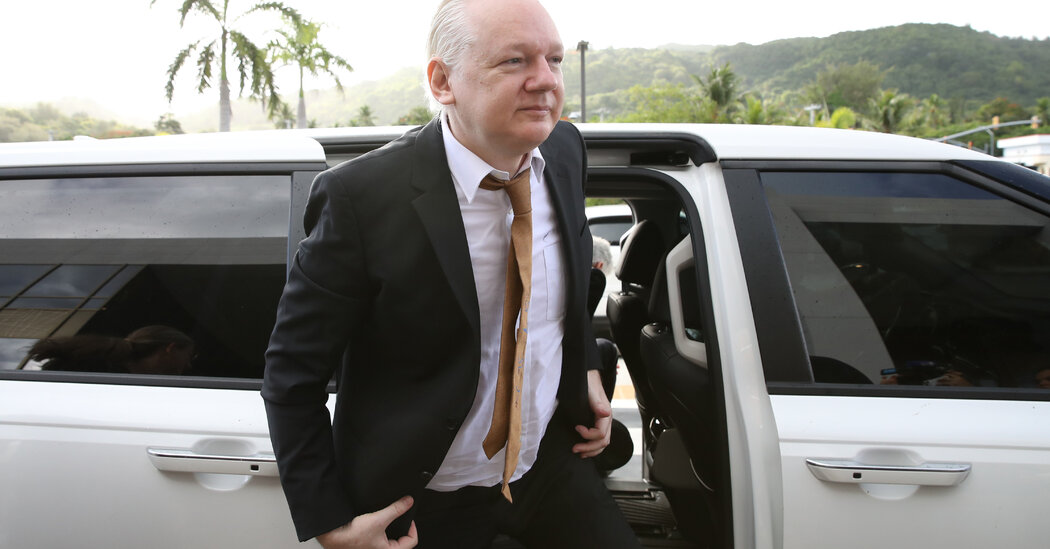
Julian Assange, the founder of WikiLeaks, pleaded guilty to a felony charge of violating the U.S. Espionage Act, securing his freedom under a plea deal that saw its final act play out in a remote U.S. courtroom in Saipan in the Western Pacific. He appeared in court wearing a black suit with his lawyer, Jennifer Robinson, and Kevin Rudd, the Australian ambassador to the United States. He stood briefly and offered his plea more than a decade after obtaining and publishing classified secret military and diplomatic documents in 2010. After a few hours of proceedings, he boarded a plane for Australia, where he was expected to arrive in the capital, Canberra, shortly before 8 p.m. It was all part of an agreement allowing Mr. Assange to return to normal life after spending more than five years in British custody — most of it fighting extradition to the United States.
His family and lawyers documented his journey from London to Bangkok and on to Saipan, capital of the Northern Mariana Islands, a U.S. commonwealth, posting photos and videos online from a chartered jet. His defense team said that in the negotiations over his plea deal, Mr. Assange had refused to appear in a court on the U.S. mainland, and that he had not been allowed to fly commercial. His wife, Stella, posted an urgent fund-raising appeal on social media platform X, seeking help in covering the $520,000 cost of the flight, which she said would have to be repaid to the Australian government. In court, Mr. Assange defended his actions, describing himself as a journalist seeking information from sources, a task he saw as legal and constitutionally protected.
In Australia, relatives, supporters, and politicians seemed eager to welcome Mr. Assange home. Prime Minister Anthony Albanese had lobbied heavily for his release and responded to the deal by noting that the case had “dragged on for too long.” Many Australians seemed to agree, noting that Chelsea Manning had already served her sentence and been set free. Despite Australia’s own strict espionage laws and deeply-entrenched culture of secrecy, which likely would have led to many years in prison had his leaks focused on the Australian government, his return won support from politicians on both the left and right. The embrace of Mr. Assange reflects what many see as both a cultural affinity for the underdog and a degree of ambivalence about America’s wars after the Sept. 11 attacks.
David Shoebridge, a Greens senator from Sydney, said in a video on X that Mr. Assange “should never have been in jail for the crime of telling the truth.” Barnaby Joyce, a conservative rural lawmaker, expressed his happiness at an Australian citizen, who never committed a crime in Australia, not being a citizen of the United States and never being charged in the United Kingdom, returning home. Julian Assange’s father, John Shipton, said having his son home after 15 years of distance and detention incarceration in one form or another was “pretty good news.”There is a widespread belief that for those at the liberal end of the political spectrum, Assange is a hero for revealing Washington’s secrets. Even conservative Australians are not as unwilling as the public rhetoric might suggest to disapprove of what Washington does.
Julian Assange, the founder of WikiLeaks, pleaded guilty to a felony charge of violating the U.S. Espionage Act, securing his freedom under a plea deal that saw its final act play out in a remote U.S. courtroom in Saipan in the Western Pacific. He appeared in court wearing a black suit with his lawyer, Jennifer Robinson, and Kevin Rudd, the Australian ambassador to the United States. He stood briefly and offered his plea more than a decade after obtaining and publishing classified secret military and diplomatic documents in 2010. After a few hours of proceedings, he boarded a plane for Australia, where he was expected to arrive in the capital, Canberra, shortly before 8 p.m. It was all part of an agreement allowing Mr. Assange to return to normal life after spending more than five years in British custody — most of it fighting extradition to the United States. His family and lawyers documented his journey from London to Bangkok and on to Saipan, capital of the Northern Mariana Islands, a U.S. commonwealth, posting photos and videos online from a chartered jet. His defense team said that in the negotiations over his plea deal, Mr. Assange had refused to appear in a court on the U.S. mainland, and that he had not been allowed to fly commercial.
In Australia, relatives, supporters, and politicians seemed eager to welcome Mr. Assange home. Prime Minister Anthony Albanese had lobbied heavily for his release and responded to the deal by noting that the case had “dragged on for too long.” Many Australians seemed to agree, noting that Chelsea Manning had already served her sentence and been set free. Despite Australia’s own strict espionage laws and deeply-entrenched culture of secrecy, which likely would have led to many years in prison had his leaks focused on the Australian government, his return won support from politicians on both the left and right. The embrace of Mr. Assange reflects what many see as both a cultural affinity for the underdog and a degree of ambivalence about America’s wars after the Sept. 11 attacks.
David Shoebridge, a Greens senator from Sydney, said in a video on X that Mr. Assange “should never have been in jail for the crime of telling the truth.” Barnaby Joyce, a conservative rural lawmaker, expressed his happiness at an Australian citizen, who never committed a crime in Australia, not being a citizen of the United States and never being charged in the United Kingdom, returning home. Julian Assange’s father, John Shipton, said having his son home after 15 years of distance and detention incarceration in one form or another was “pretty good news.” There is a widespread belief that for those at the liberal end of the political spectrum, Assange is a hero for revealing Washington’s secrets. Even conservative Australians are not as unwilling as the public rhetoric might suggest to disapprove of what Washington does.