



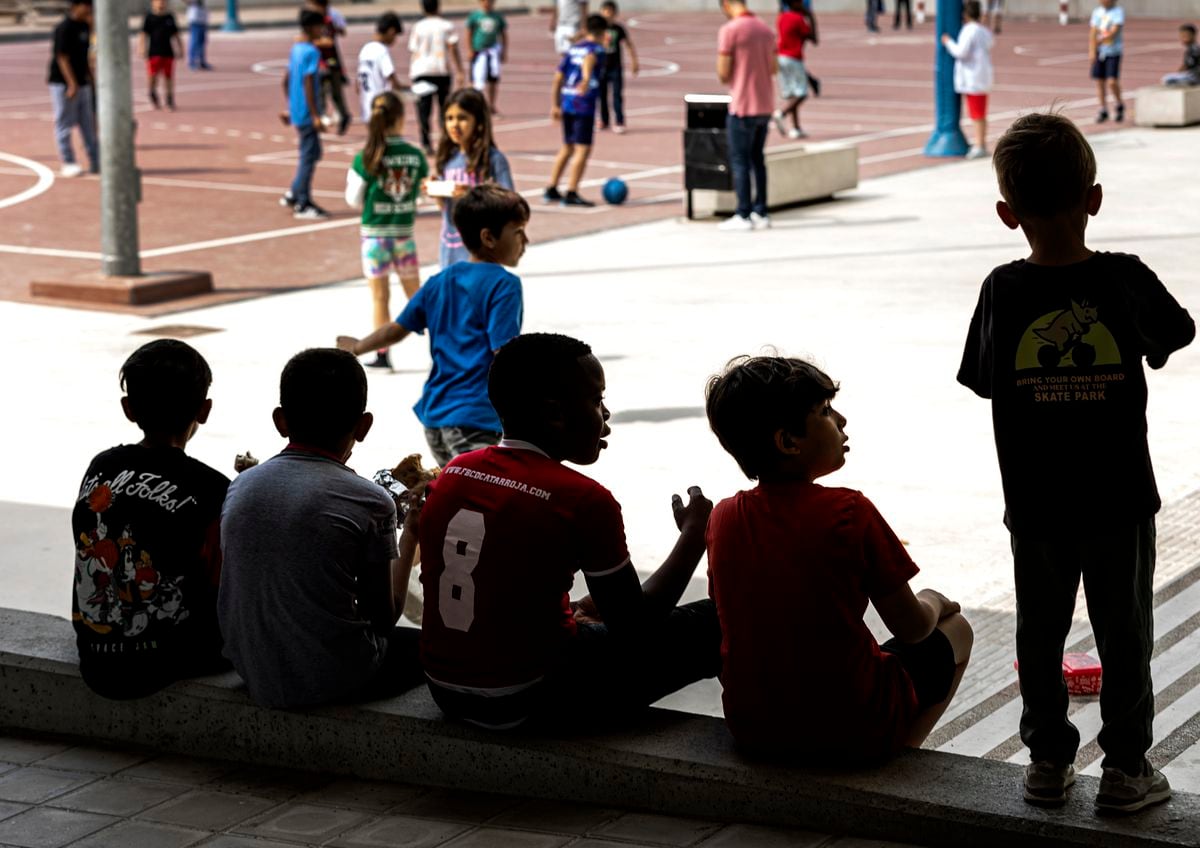
The rate of repeating students in Spain has once again decreased, according to data from the past academic year published by the Ministry of Education. This decrease has been particularly significant in primary education, where it dropped by almost half (from 2.1% to 1.1%), reaching the lowest level on record. Even lower than during the extraordinary academic year of 2020-2021, when educational authorities agreed to relax rules to compensate for the three-month closure of schools due to the pandemic. In Secondary Education (ESO), the rate decreased more moderately (from 7.6% to 7%), and in Bachillerato it dropped by one percentage point (from 6.9% to 5.9%).
International organizations and experts have been warning Spain for years that its repetition rates are very high, among the highest in the European Union. Despite evidence showing that repeating a grade usually does not improve students’ academic performance (often has the opposite effect), it is costly for the education system (funds that could be used for more useful measures), and is applied unfairly (a low-income student with the same level of math and science as a wealthy student is four times more likely to repeat in Spain, as shown in the latest PISA report from the OECD in December).
The new data shows a return to the gradual decline in repetition rates that has been ongoing for years with some fluctuations. The first year of the pandemic was an exception, as measures taken at that time drastically reduced repetition rates in all stages of education. However, a year later, there was a rebound that reversed most of that progress. The pandemic period shows a V-shaped pattern on the repetition graph. Now, the downward trend is being recovered, stimulated by changes introduced by the new education law, the Lomloe. Jorge Delgado, president of the federation of public elementary school principals Fedeip, notes that repetition in this stage had already been decreasing. However, new repetition rules introduced by the Lomloe, such as only allowing repetition at the end of each of the three cycles in primary education, and the implementation of measures for diversity, are making repetition a truly exceptional measure, unlike in the past where it was frequently used.
Changes brought by the Lomloe, including the maximum number of times a student can repeat a grade throughout basic education (from age six to 16), and the decision to promote to the next grade being based on what the teaching team deems beneficial for the student’s education trajectory, are contributing to the improvement of repetition rates. Ricardo Civera, a member of the board of directors of the association of public school principals in Aragon, believes that reinforcement programs, like the PROA+ program funded by the Ministry of Education and others implemented by the autonomous communities, are also helping socially disadvantaged students. Despite legislation in Spain stating that grade repetition should be exceptional, it has been fairly common in practice, especially when compared to other countries in the region.
There are significant differences in repetition rates among regions and between public and private education. Two of the top-performing regions in the latest PISA report, Asturias and Cantabria, have lower repetition rates than the national average in primary, ESO, and Bachillerato. Castilla y León, the region with the best results, only has lower repetition rates in ESO. In primary education, regions with the highest repetition rates are Castilla-La Mancha (2.8%) and Murcia (2.5%), while Catalonia (0.4%) and Asturias (0.6%) have the lowest rates. In ESO, Murcia (9.3%) and Castilla-La Mancha (9.3%) have the highest rates, with Catalonia (2.7%) and Asturias (4.6%) having the lowest. In Bachillerato, Castilla y León (9.5%) and the Balearic Islands (7.1%) have the highest rates, while the Basque Country (3.8%) and La Rioja (3.9%) have the lowest. The statistics show a significant gap between public and private education, with lower repetition rates in private schools.
In conclusion, the reduction in repetition rates in Spain, especially in primary education, can be attributed to various factors, including changes in legislation, the implementation of support programs for socially disadvantaged students, and a shift towards a more personalized and holistic approach to student assessment and promotion. While there is still room for improvement, particularly in narrowing the gap between public and private education, these developments are positive steps towards creating a more inclusive and effective education system in Spain.