





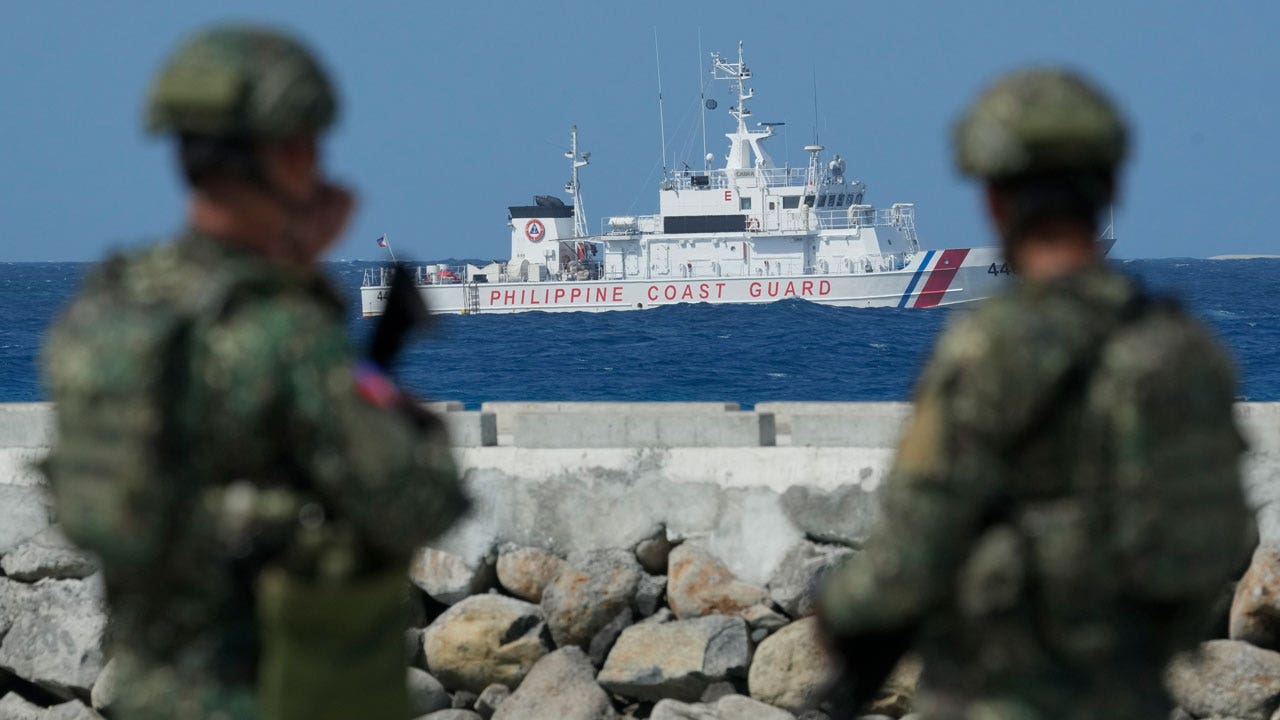
China has recently made public an alleged unwritten 2016 agreement with the Philippines regarding access to South China Sea islands, which has the potential to escalate tensions in the disputed region. The agreement, which was described as a “temporary special arrangement,” allowed for small-scale fishing around the islands but restricted access by military, coast guard, and other official ships and planes to the territorial waters. The statement from the Chinese Embassy in Manila claimed that the Philippines had respected the agreement for seven years but had now reneged on it for its political agenda, leading to ongoing disputes at sea between the two countries.
There have been denials from both President Ferdinand Marcos Jr. and former President Rodrigo Duterte about any agreements that would surrender Philippine sovereignty to China. Duterte had hinted at such an agreement during his visit to Beijing in 2016, where he boasted of securing Philippine fishermen access to Scarborough Shoal. Marcos, who took office in June 2022, stated that China had insisted on the existence of a secret agreement, but he was not aware of it. He emphasized that he was rescinding any such agreement, should it exist.
Duterte had maintained warm relations with Chinese President Xi Jinping during his presidency, while being openly hostile to the United States. He acknowledged an agreement to maintain the status quo in the disputed waters with China to avoid conflict. House Speaker Ferdinand Martin Romualdez, Marcos’s cousin, has ordered an investigation into the so-called “gentleman’s agreement” between the Philippines and China. China has also claimed that Philippine officials promised to tow away a navy ship grounded in the Second Thomas Shoal in 1999, which the Philippines denies knowledge of.
Apart from China and the Philippines, other countries like Vietnam, Malaysia, Taiwan, and Brunei have overlapping claims in the South China Sea, which is rich in fishing stocks, gas, and oil. Beijing has rejected a 2016 international arbitration ruling that invalidated its expansive claims in the region on historical grounds. Tensions between China and the Philippines have escalated, with incidents involving Chinese coast guard vessels firing water cannons at Philippine patrol ships, leading to minor clashes. The U.S. has conducted freedom of navigation operations in the region and has vowed to defend the Philippines in case of any armed attacks in the South China Sea.
Overall, the disclosure of the alleged agreement between China and the Philippines regarding access to South China Sea islands has the potential to further fuel tensions in the heavily disputed region. Both countries have denied any agreements that would compromise their sovereignty, with ongoing investigations into the matter. The South China Sea claims by multiple countries, coupled with the refusal of China to recognize international arbitration rulings, continue to be a source of conflict and contention in the region. While the U.S. has taken a stance in challenging China’s claims and has pledged to defend its ally, the Philippines, the situation remains highly volatile with regular skirmishes between countries.