






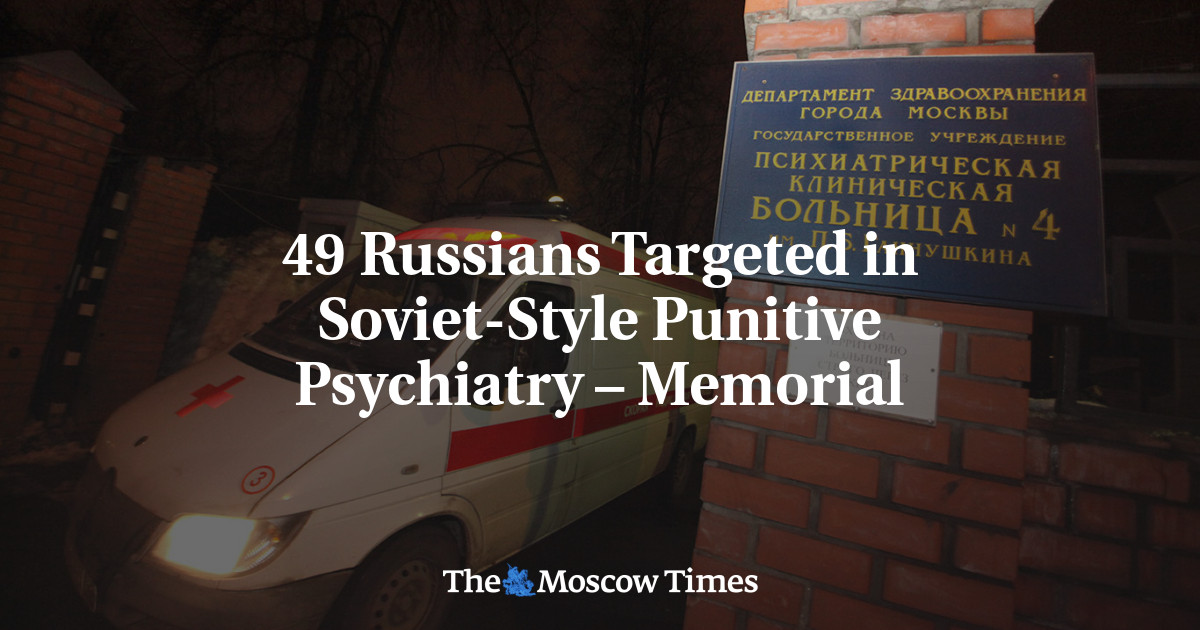
At least 49 Russian citizens are currently being held in mental hospitals as a form of punishment against opposition and other activists, according to human rights group Memorial. This practice of punitive psychiatry in Russia has its roots in the Soviet Union, where it was used as a tool for repression. Memorial highlighted the use of mental health issues as a pretext for cracking down on anyone deemed “undesirable,” ranging from activists to Muslims, scientists, and musicians. Political prisoners subjected to punitive psychiatry have described experiencing humiliating treatment, including beatings and injections with potent drugs. Compulsory treatment is enforced on these activists until they are deemed to have fully recovered, which often results in indefinite confinement.
Yakutian shaman Alexander Gabyshev, who was arrested over five years ago for his mission to “exorcize” President Vladimir Putin from the Kremlin, is among the Russians subjected to psychiatric treatment for the longest period – three years and eight months. During the Soviet era, punitive psychiatry was rampant, with a significant number of dissidents accused of political crimes being declared mentally ill. This history sheds light on the ongoing use of psychiatric institutions as a means of silencing dissent and punishing individuals who challenge the authorities in Russia. Memorial’s report on this issue comes in the context of World Mental Health Day, drawing attention to the misuse of psychiatric treatment for political purposes.
The punitive psychiatric treatment described by Memorial involves subjecting individuals to degrading conditions and coercive measures until they conform to the authorities’ definition of recovery. This often results in the prolonged confinement of activists, further highlighting the repressive nature of the practice. The statement from Memorial underscores the struggles faced by those who are deemed undesirable by the Russian government and calls attention to the human rights violations inherent in the use of punitive psychiatry. By highlighting individual cases like that of Alexander Gabyshev, who has spent years in psychiatric confinement for his activism, the report sheds light on the personal toll of these repressive tactics.
The legacy of punitive psychiatry in Russia, stemming from the Soviet era, continues to be a tool of repression against dissidents, activists, and individuals critical of the government. Memorial’s documentation of at least 49 Russian citizens currently detained in mental hospitals for political reasons highlights the extent to which mental health institutions are exploited for punitive purposes. The fact that individuals can be held indefinitely until authorities determine their “recovery” raises concerns about the lack of due process and the arbitrary nature of such confinement. The case of Alexander Gabyshev serves as a poignant example of the lengths to which the government will go to silence those who challenge the status quo.
The human rights violations associated with punitive psychiatry, as detailed by Memorial, raise urgent concerns about the use of mental health institutions as tools of repression in Russia. The allegations of beatings, injections with strong drugs, and indefinite confinement paint a grim picture of the treatment faced by political prisoners subjected to this form of punishment. The prevalence of punitive psychiatry within the Russian penal system underscores the challenges faced by those who speak out against the government and advocate for change. These practices not only violate the rights of individuals but also contribute to a climate of fear and intimidation that impedes freedom of expression and dissent in the country.
The experiences of individuals like Alexander Gabyshev, who have been detained for years in mental hospitals for their activism, highlight the personal toll of punitive psychiatry in Russia. The prolonged confinement, coercive treatment, and lack of recourse for those deemed mentally ill for political reasons underscore the urgent need for international attention and advocacy on this issue. Memorial’s report serves as a stark reminder of the continued use of punitive psychiatry as a means of silencing dissent in Russia and the importance of holding authorities accountable for such human rights abuses. By shedding light on these cases, activists and human rights organizations aim to pressure the Russian government to end the practice of using mental health institutions as tools of repression and coercion.