





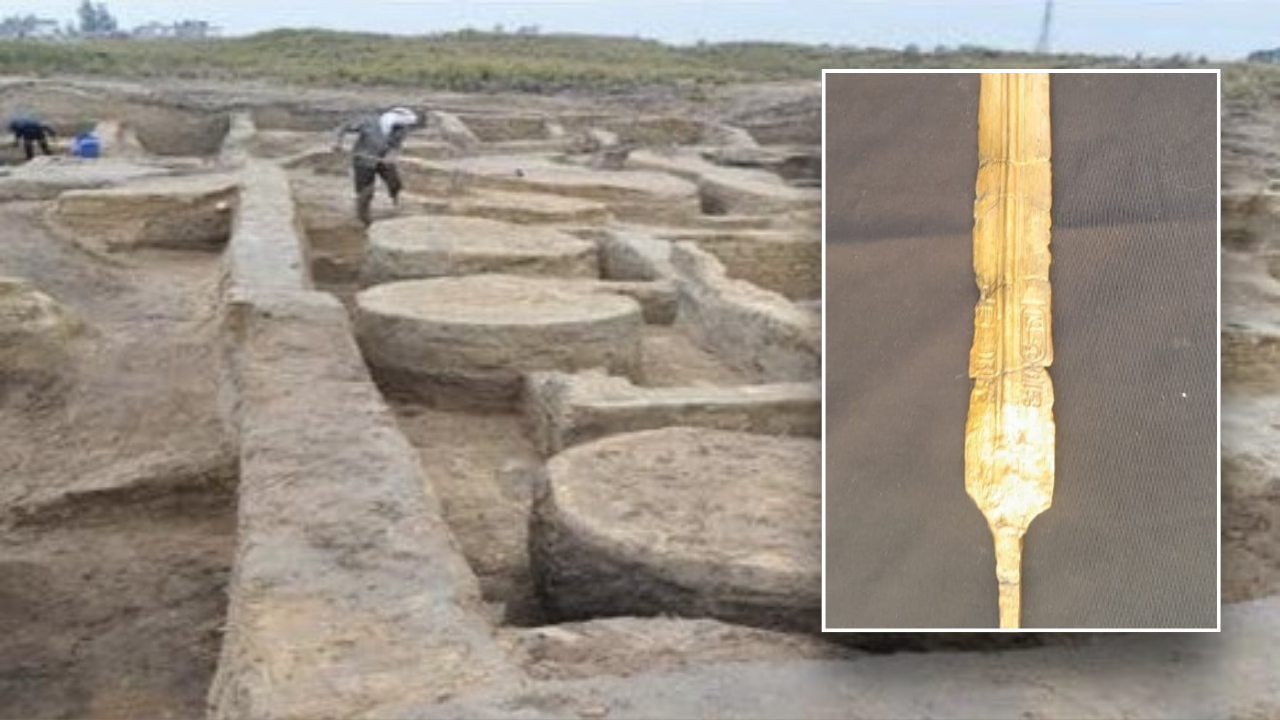
Egyptian archaeologists recently discovered an ancient sword in Housh Eissa, a city in the Beheira Governorate, belonging to the military of Ramesses II. This pharaoh is believed to have been referenced in the Book of Exodus. The artefact, a bronze sword with the hieroglyphic symbol of Ramesses, was found in Tell Al-Abqain, alongside other items such as military barracks, storage rooms, and personal items belonging to soldiers. These relics offer insight into the daily lives, religious beliefs, and military activities of the fort’s occupants during the New Kingdom era.
In addition to the sword, a range of artifacts, including weapons, tools, hygiene items, and jewelry, were discovered at the site. These items, such as ivory kohl applicators, carnelian and faience beads, scarabs, and protective amulets, shed light on the material culture of ancient Egypt during Ramesses II’s reign. The fort where these relics were found served as a key outpost, protecting Egyptian borders from the Sea Peoples, a group of tribes that attacked Egypt. The barracks and storage rooms discovered at the site were meticulously designed, reflecting the engineering ingenuity of ancient Egypt.
Ramesses II, who reigned from 1303 B.C. to 1213 B.C., is believed to be the pharaoh mentioned in the Book of Exodus, where Moses led enslaved Israelites out of Egypt to the Desert of Paran. While the biblical account does not explicitly name the pharaoh, most scholars attribute the reference to Ramesses. Dr. Mohamed Ismail Khaled, Secretary-General of the Supreme Council of Antiquities, emphasized the historical significance of the fort where the artifacts were unearthed, highlighting its strategic importance in defending against external threats such as the Sea Peoples.
The discovery of the ancient sword and other relics at Tell Al-Abqain offers a glimpse into the military and daily life of ancient Egypt during the New Kingdom era. The presence of military barracks, storage facilities, and personal items belonging to soldiers provides valuable information about the architectural layout and organization of ancient Egyptian outposts. The artifacts found at the site not only reflect the material culture of the time but also contribute to our understanding of the historical context in which Ramesses II ruled and interacted with neighboring civilizations.
The excavation in Housh Eissa represents a significant find in the field of archaeology, shedding light on the military activities and defensive strategies of ancient Egypt under the reign of Ramesses II. The discovery of the bronze sword with the pharaoh’s cartouche, along with other relics, underscores the rich archaeological heritage of Egypt and the importance of ongoing research and exploration in uncovering the secrets of the past. The fort at Tell Al-Abqain serves as a tangible link to Egypt’s ancient history, providing a window into the lives of the soldiers who defended the borders and protected the kingdom from external threats.
Overall, the recent archaeological discovery in Housh Eissa offers valuable insights into Egypt’s military history, material culture, and strategic defense during the New Kingdom era. The artifacts found at the site, including the ancient sword of Ramesses II, provide a tangible connection to the past and contribute to our understanding of ancient Egyptian society. The excavation at Tell Al-Abqain highlights the importance of preserving and studying archaeological sites to unravel the mysteries of the past and uncover the rich heritage of civilizations that have shaped human history.