




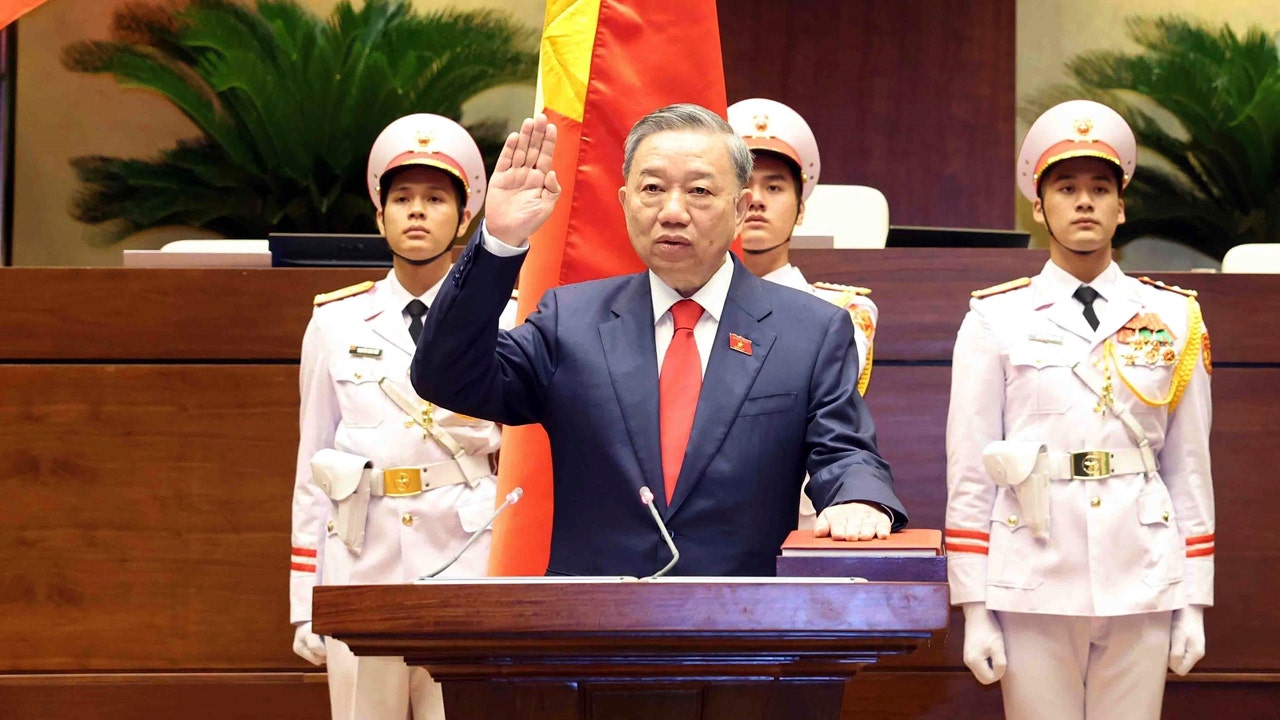
Vietnam’s National Assembly has confirmed To Lam as the country’s new president, a largely ceremonial position that could potentially lead him to become the next Communist Party general secretary. Lam, previously the top security official in Vietnam, has overseen police and intelligence operations during a time when the country’s human rights record has been criticized, and the secret service has been accused of violating international law. His appointment comes amid an anti-corruption campaign that has resulted in significant changes in the country’s political landscape.
With the recent confirmation of the 66-year-old To Lam as president, he is seen as being in a strong position to potentially succeed the current Communist Party general secretary, Nguyen Phu Trong. However, Trong, who was elected to a third term in 2021, may not seek another term after 2026 due to his age. Lam has been at the forefront of Trong’s anti-corruption campaign as the top security official in Vietnam, leading investigations into high-profile politicians. His rise to the presidency comes at a time of significant political instability in the country.
Vietnam’s political system has experienced unprecedented instability, with multiple high-level resignations and changes within the government. This uncertainty has caused concern among investors as the country tries to position itself as an alternative manufacturing hub to China. Economic growth has slowed, and foreign investment has waned as a result. Despite initial expectations that Vietnam could join the ranks of the “Four Asian Tigers,” the recent scandals and bureaucratic challenges have hindered its progress.
Under Lam’s tenure as the head of Vietnam’s Ministry of Public Security, human rights organizations have criticized the government for its suppression of civil liberties, harassment of activists, and censorship of social media. The country has faced international backlash for the abduction of former politician Trinh Xuan Thanh in Germany in 2017. The relationship between Vietnam and Germany remains strained due to the incident, which led to the conviction of several individuals involved in the abduction.
With Lam’s ascent to the presidency, concerns about further repression and censorship have been raised by advocacy groups. Vietnam is perceived as a police state, with a ruling Politburo dominated by security officials. The crackdown on dissent and criticism has intensified under Lam’s leadership, raising alarms among human rights activists. The country’s image has been tarnished by incidents such as the Salt Bae steak video controversy and the abduction of Trinh Xuan Thanh, further damaging its international reputation.
As Vietnam grapples with political instability, economic challenges, and human rights concerns, the future remains uncertain. The appointment of To Lam as president has raised questions about the country’s direction and its ability to address these issues. Investors, activists, and international partners are closely watching Vietnam’s trajectory as it navigates these complex and interconnected challenges.