





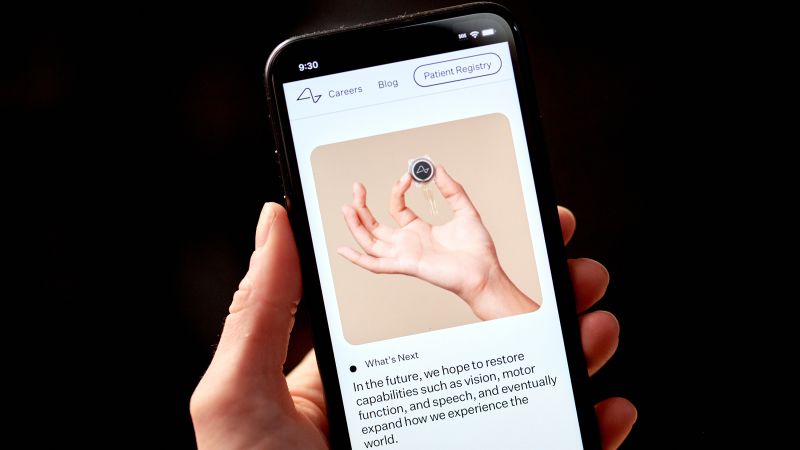
Neuralink, Elon Musk’s brain chip implant startup, recently experienced an issue with its first test subject, Noland Arbaugh, who had the chip inserted. Some of the chip’s connective threads retracted from Arbaugh’s brain, impacting the implant’s data speeds and effectiveness. The company made adjustments to make the implant more sensitive in response to this issue but did not provide many details about how the threads became detached. Arbaugh, who has been a quadriplegic since 2016, was implanted with the chip as part of a trial called PRIME Study, which aims to study the safety and functionality of the implant and surgical robot.
The trial patients have chips placed in the part of the brain that controls the intention to move, with the goal of allowing individuals to control a computer cursor or keyboard using their thoughts alone. Arbaugh was able to control a computer mouse with his brain about a month after the operation, showcasing some of the initial successes of Neuralink’s technology. Ultimately, Neuralink’s ambition is to use implants to connect human brains to computers, enabling paralyzed individuals to control devices or blind individuals to regain sight. The company’s implant collects electrical signals from the brain and interprets them as actions, similar to existing brain-machine interfaces.
Elon Musk has described Neuralink’s first product, Telepathy, as a way for individuals who have lost the use of their limbs to communicate faster than a speed typist or auctioneer, highlighting the company’s goal of enabling seamless brain-computer communication. However, widespread consumer access to this technology is not imminent, as Neuralink’s brain implants will require broader regulatory approval before hitting the market. The company has already received clearance from the Food and Drug Administration for trials and has informed the agency about the issue with Arbaugh’s implant, as reported by the Wall Street Journal.
Neuralink’s vision for connecting human brains to computers holds significant promise for assisting individuals with disabilities in controlling devices or regaining sensory functions. The technology has the potential to significantly improve quality of life for those with physical impairments, offering new ways to interact with technology through brain signals. While the incident with Arbaugh’s implant raises concerns about the reliability and safety of the technology, the company’s ability to address and improve on these issues demonstrates its commitment to advancing the field of brain-computer interfaces. With further research and development, Neuralink aims to revolutionize how humans interact with technology and overcome physical limitations.
The PRIME Study and subsequent trials conducted by Neuralink provide valuable insights into the safety and efficacy of brain implants, paving the way for future advancements in the field of neurotechnology. By testing the functionality of the implant and surgical robot, the company can refine its technology and address any shortcomings to ensure the best outcomes for patients. The successful implementation of brain-computer interfaces could open up new possibilities for individuals with disabilities, offering them greater independence and control over their environment through the power of thought. Neuralink’s dedication to pushing the boundaries of what is possible in brain-machine interfaces shows promise for a future where such technologies are more widely accessible and integrated into everyday life.
As Neuralink continues to refine its technology and address any issues that arise, the potential for brain implants to enhance human capabilities and improve quality of life becomes increasingly apparent. By enabling individuals to interface with technology through their thoughts, Neuralink opens up a world of possibilities for individuals with physical limitations, allowing them to communicate, navigate, and interact with the world in ways previously unimaginable. While there are still hurdles to overcome in terms of regulatory approval and scalability, Neuralink’s groundbreaking work in brain-computer interfaces offers hope for a future where seamless interactions between humans and machines are not just a possibility but a reality.