






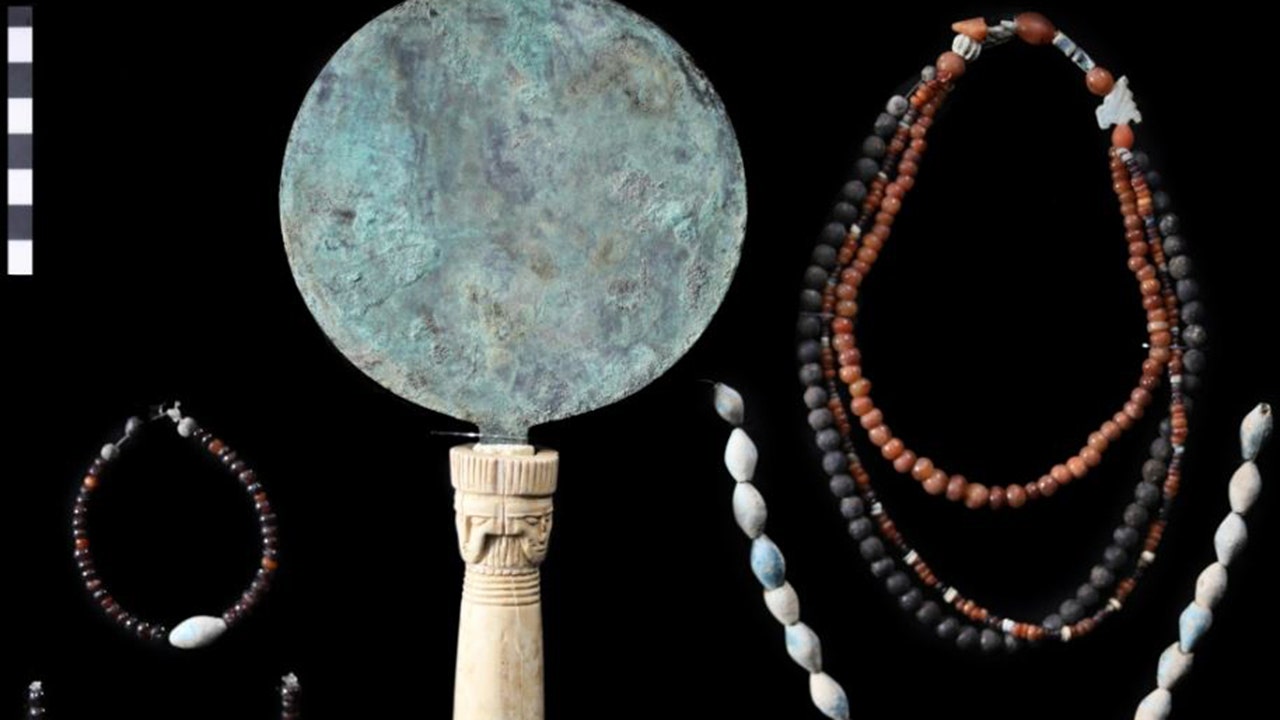
Archaeologists working near Luxor, Egypt, have discovered a 4,000-year-old Middle Kingdom tomb containing eleven intact burials. The tomb also contained jewelry, copper mirrors with ivory handles, scarab rings, and girdles made of carnelian, garnet, faience, and feldspar. The discovery was made by a joint American and Egyptian expedition led by Dr. Elena Pischikova, director of the South Asasif Conservation Project. The tomb, found in the South Asasif necropolis, likely belonged to a family, as it contained the skeletons of five women, two men, and three children, along with various artifacts such as necklaces, bracelets, and armlets.
Among the items found in the tomb were a necklace made of amethyst and agate beads surrounding a hippo head amulet, as well as a green-blue glazed faience fertility figurine with a variety of jewelry and lozenge markings on the legs and torso. The figurine’s head was pierced with holes intended for the attachment of “hair,” which was originally made up of almost 4,000 mud beads. The wooden coffins and fine linens found inside the tomb were mostly destroyed by ancient floods, but the artifacts found provide valuable insight into burial practices and rituals of the Theban necropolis in the Middle Kingdom.
This discovery marks the first Middle Kingdom tomb found in the South Asasif necropolis, next to the Temple of Hatshepsut on the Nile’s West Bank in Luxor. The unearthing of this tomb alters the history of the area, placing South Asasif within the sprawling Theban Middle Kingdom necropolis. The findings contribute significantly to the understanding of burial practices and rituals during the Middle Kingdom, as well as providing a well-preserved collection of exquisitely crafted jewelry at the site. The excavations were led by the South Asasif Conservation Project, which aims to preserve and study the ancient heritage of Luxor and its surroundings.
Luxor, located in southern Egypt, is rich in archaeological treasures, with hundreds of tombs uncovered over the years. Tutankhamen, one of the most famous residents of Luxor, was an Egyptian pharaoh who ruled from circa 1332-1323 B.C. His tomb was famously discovered in 1922. The recent discovery of the Middle Kingdom tomb near Luxor adds to the wealth of historical and cultural heritage in the region, shedding light on ancient burial practices and providing a fascinating glimpse into the lives of the people who lived there thousands of years ago.
Overall, the discovery of the Middle Kingdom tomb near Luxor by a joint American and Egyptian expedition led by the South Asasif Conservation Project has provided valuable insights into ancient burial practices and rituals. The well-preserved artifacts found in the tomb, including jewelry, copper mirrors, and a fertility figurine, offer a glimpse into the lives of the people who lived in the area during the Middle Kingdom. The discovery has also altered the history of the South Asasif necropolis, positioning it within the Theban Middle Kingdom necropolis. Luxor’s rich archaeological heritage continues to fascinate researchers and visitors alike, with discoveries like this contributing to a deeper understanding of ancient Egyptian culture and history.