





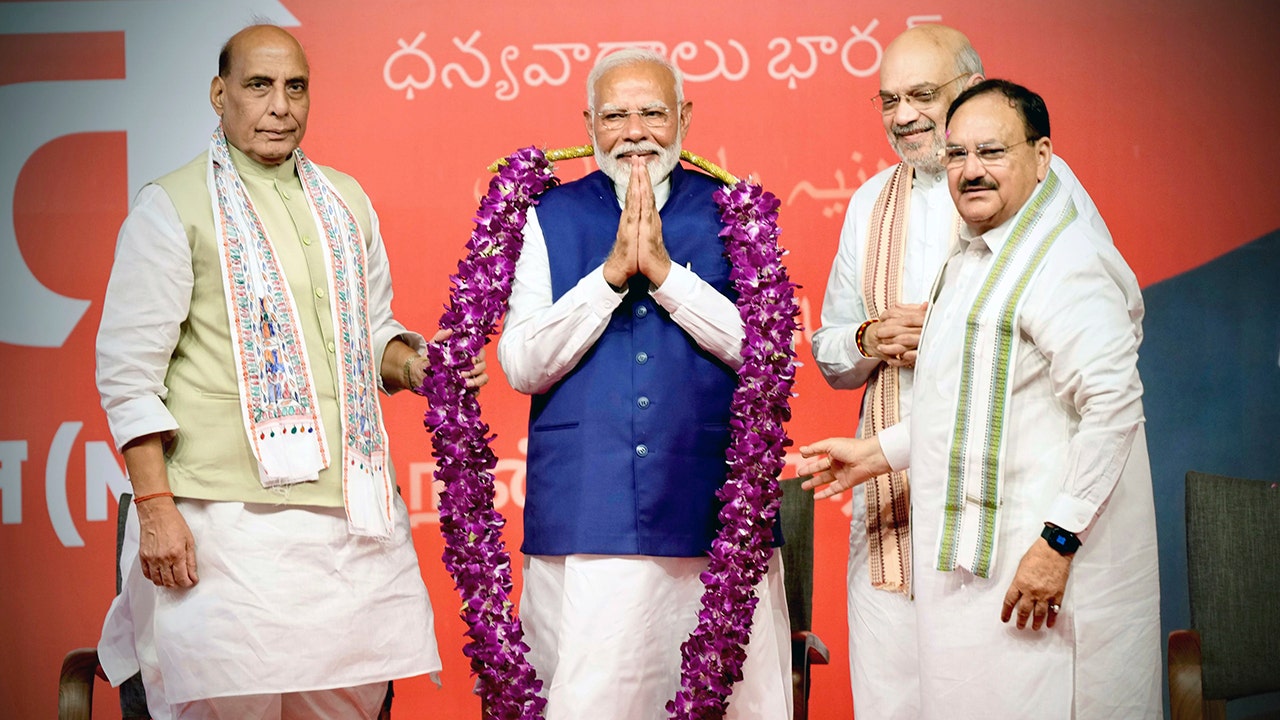
Indian Prime Minister Narendra Modi recently won a third straight term in a controversial election that some saw as a referendum on his governance. Modi, a popular but polarizing figure, has led India to become the world’s fifth-largest economy and has implemented various welfare programs that benefit a majority of the population. However, critics argue that under his rule, inequalities have increased, and his divisive politics have targeted Muslims and eroded democracy within the country.
Despite facing a stronger challenge from the opposition in the recent election, Modi secured a slim parliamentary majority with his National Democratic Alliance and was able to form a third consecutive government. His victory was attributed to his social welfare programs and Hindu nationalist rhetoric that has garnered support from the majority Hindu population in India. Critics of Modi’s leadership claim that he has undermined democratic institutions and has used authoritarian tactics to silence dissenting voices.
Modi’s campaign leading up to the election focused on his administration’s welfare policies and promised to turn India into a developed country by 2047. However, as the campaign progressed, Modi resorted to anti-Muslim rhetoric, accusing the opposition of pandering to the minority community and portraying Muslims as “infiltrators.” The Prime Minister has also hinted at being chosen by God, further aligning himself with Hindu nationalist beliefs.
Born to a lower-caste family in Gujarat, Modi began his political career with the Rashtriya Swayamsevak Sangh, an organization known for promoting Hindu nationalism. He became Chief Minister of Gujarat in 2001, during which anti-Muslim riots erupted in the region. Modi was accused of quietly supporting the violence, but investigations cleared him of any wrongdoing. Since taking office, Modi’s government has revoked the special status of Kashmir, passed laws that discriminate against Muslims, and advanced Hindu nationalist policies in India.
Modi’s leadership style has been characterized by his embrace of Hindu nationalism, which has propelled him to popularity among his supporters. However, critics argue that his policies have fueled intolerance and discrimination against minorities, especially Muslims. Despite these controversies, Modi continues to be seen as a champion for the Hindu majority and a symbol of India’s emergence as a Hindu majoritarian state. Moving forward, the impact of Modi’s divisive politics and authoritarian tendencies on India’s democracy remains a subject of debate among political analysts and observers.