



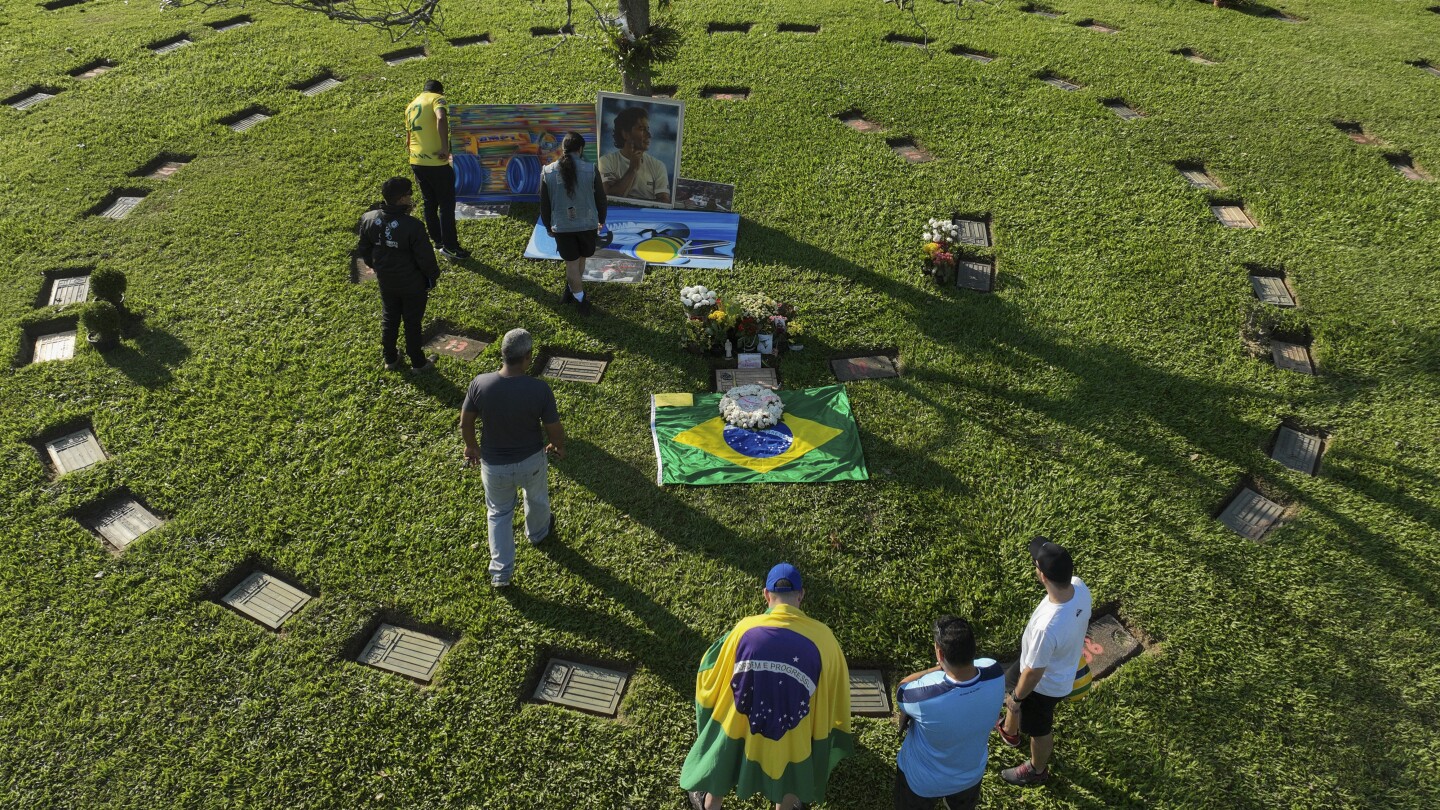
The 30th anniversary of the death of three-time F1 champion Ayrton Senna was commemorated with a memorial at the Imola track where he crashed during the 1994 San Marino Grand Prix. Formula One CEO Stefano Domenicali, along with hundreds of fans and politicians from Brazil, Italy, and Austria, paid tribute to Senna and fellow driver Roland Ratzenberger, who also died during the same race weekend. A minute of silence was observed at 2:17 p.m. to mark the exact time and place of Senna’s fatal crash at the Tamburello curve, as well as at the Villeneuve corner where Ratzenberger crashed. Senna, a Brazilian driver who had won F1 titles in 1988, 1990, and 1991, was leading the race in Imola when the tragic accident occurred.
Italy’s Foreign Minister Antonio Tajani highlighted the significance of Senna and Ratzenberger in sports history and beyond, acknowledging their lasting impact. The attention brought about by Senna’s death led to safety improvements at the Imola track and across the F1 circuit. These enhancements included shorter straights, increased space around dangerous corners, and the implementation of less powerful engines in an effort to enhance driver safety. The legacy of Senna and Ratzenberger remains a key part of the history of Formula One, serving as a reminder of the risks and sacrifices involved in the sport.
The memorial event at Imola attracted a significant turnout of fans and dignitaries, reflecting the enduring legacy of Senna and Ratzenberger in the world of motorsport. The tragic events of the 1994 San Marino Grand Prix serve as a somber reminder of the dangers faced by drivers in high-speed racing competitions. The commemoration ceremony served to honor the memory of both drivers and to acknowledge their contributions to the sport, as well as the broader impact on safety measures in Formula One. The continued reverence for Senna and Ratzenberger highlights their lasting influence on the sport and the ongoing efforts to prioritize safety in motorsport.
As Formula One continues to evolve and improve its safety standards, the memory of Ayrton Senna and Roland Ratzenberger serves as a poignant reminder of the risks involved in high-speed racing. The tragic events at Imola in 1994 spurred significant changes within F1, leading to a renewed focus on driver safety and track improvements. The anniversary memorial at the Imola track allowed fans, officials, and dignitaries to come together in remembrance, paying tribute to two drivers who made a lasting impact on the sport. The legacy of Senna and Ratzenberger lives on through the continued efforts to enhance safety in Formula One and ensure that tragedies like the ones in 1994 are not repeated.