





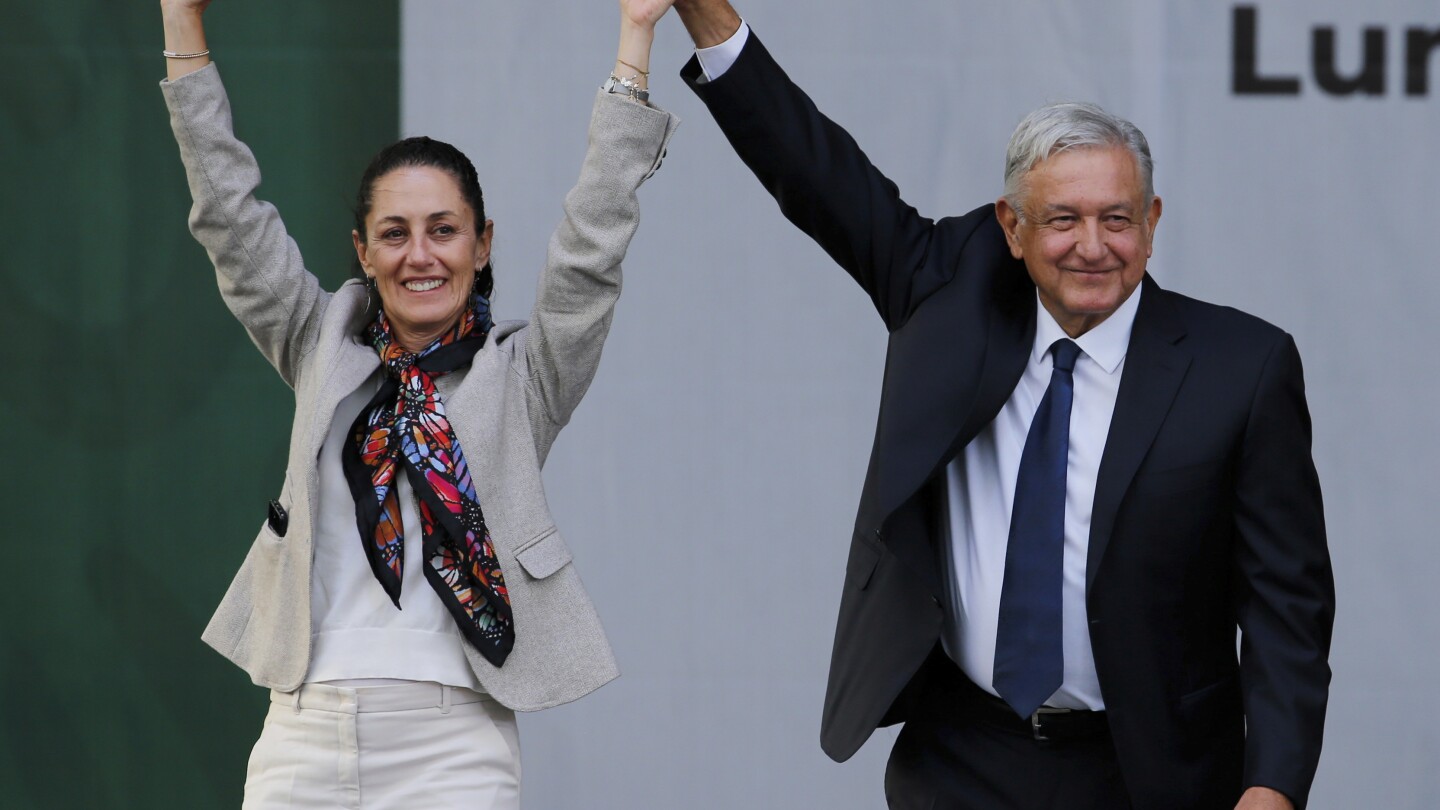
Mexican presidential candidate Claudia Sheinbaum is facing challenges in establishing her own identity separate from that of outgoing President Andrés Manuel López Obrador. Despite being the frontrunner for the upcoming election, Sheinbaum has had to adopt many of López Obrador’s popular programs as a candidate for the Morena party. However, her background suggests a more solidly leftist tradition that predates López Obrador’s movement, with her parents being activists in Mexico’s 1968 student democracy movement. Sheinbaum’s challenge lies in constructing her own image while still aligning with López Obrador’s legacy.
Sheinbaum’s campaign is focused on positioning her as a progressive candidate, with roots in the leftist movement of the 1960s and 70s. However, she has faced criticism for her dismissive demeanor towards others, especially when it comes to discussing human rights issues. Despite this, she has shown flashes of rebellion against López Obrador, particularly during the coronavirus pandemic when she wanted to implement a stricter lockdown to curb the spread of the virus. This suggests that Sheinbaum may have her own ideas and priorities that differ from López Obrador’s.
As a former academic and energy-engineering specialist, Sheinbaum is interested in promoting renewable energy and science-based solutions. She also advocates for using digital technology to address issues such as Mexico’s low tax collection rate and violence against women. However, she must be cautious in presenting new proposals to avoid conflicting with López Obrador, upon whose supporters she relies. Balancing her own ideas with the established programs of the outgoing president is a delicate act for Sheinbaum, who aims to become Mexico’s first female president in the upcoming election.
Despite challenges in defining her own platform, Sheinbaum has made some progress in connecting with voters through her campaign. With slogans like “Es Claudia” and “Es Tiempo de Mujeres,” she emphasizes her candidacy as a historic moment for women in Mexico. Her focus on government support programs and social initiatives has resonated with supporters, even as she navigates the constraints of López Obrador’s legacy. At campaign rallies, she engages with voters, even though her demeanor may appear reserved compared to the outgoing president.
Looking ahead to the election, Sheinbaum faces the task of uniting a divided country and implementing policies that address the challenges Mexico is currently facing. Whether she will be able to steer the country in a new direction or maintain continuity with López Obrador’s administration remains to be seen. With her academic background and progressive ideals, Sheinbaum has the opportunity to carve out a unique path for herself as a leader in Mexican politics. As the June 2 presidential election approaches, all eyes will be on Claudia Sheinbaum and her vision for the future of Mexico.