



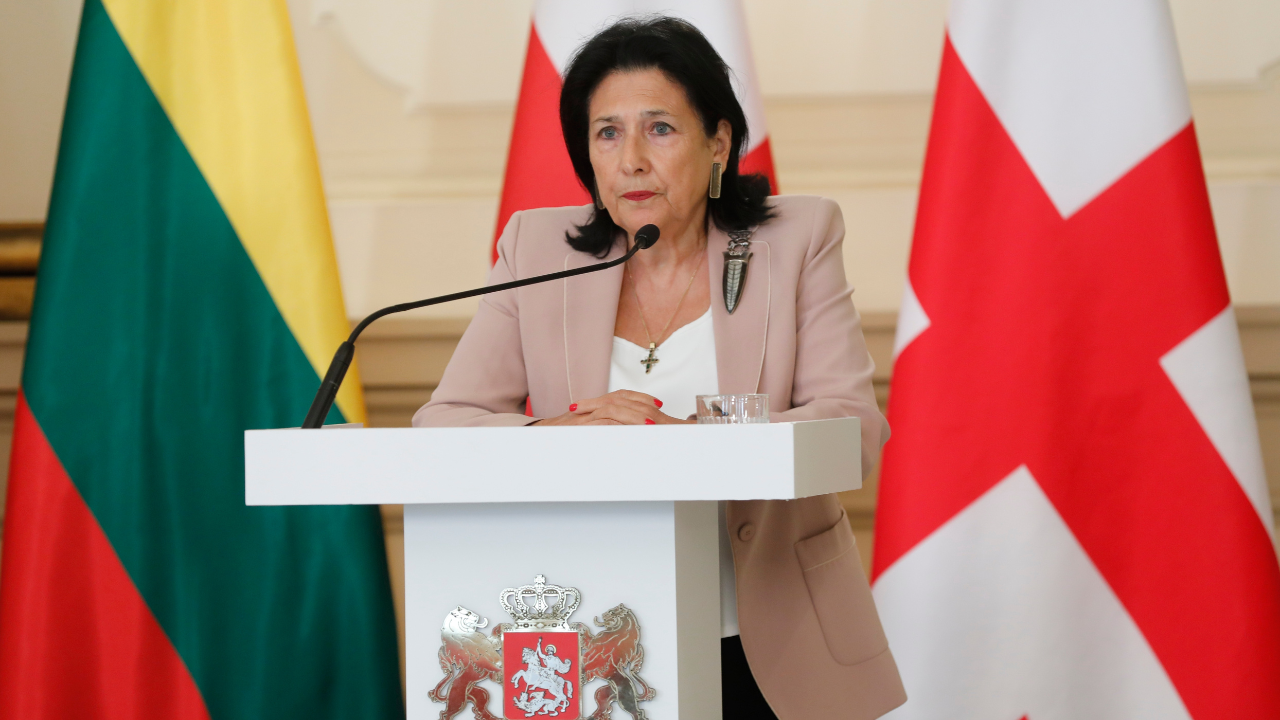
President Salome Zourabichvili of Georgia criticized a controversial media bill passed by the parliament as “unacceptable” and vowed to veto it. The bill requires media and nonprofits receiving more than 20% of their funding from abroad to register as “pursuing the interests of a foreign power.” The U.S. has expressed concern over the legislation, warning of potential repercussions, as it is seen as a threat to free speech and Georgia’s aspirations to join the European Union. Zourabichvili emphasized her duty to support European integration and denounced the ruling party’s push for the bill.
Despite massive protests from the public, Georgia’s parliament approved the bill 84-30. The bill is similar to one that was withdrawn last year after street protests, but this renewed version has faced continued opposition. Zourabichvili warned that Georgia should focus on passing necessary laws to qualify for EU accession talks rather than passing controversial legislation that conflicts with European values and objectives. Renewed demonstrations have led to clashes between protesters and police, who have used tear gas and water cannons to disperse crowds.
Zourabichvili’s criticism of the legislation as a threat to democratic principles and the rule of law has been echoed by the U.S., with White House press secretary Karine Jean-Pierre stating that the bill moves Georgia further away from European and NATO values. U.S. Assistant Secretary of State for Europe and Eurasia Affairs James O’Brien has met with Georgian officials to express concern about the potential impact of the law on democracy and peaceful protests. The government’s actions in passing the bill have caused tensions with the U.S. and raised the possibility of restrictions on the relationship between the two countries.
The bill has sparked outrage from the public, with huge crowds of protesters blocking streets in the capital of Tbilisi and demonstrating outside the parliament building. The opposition has labeled the legislation as the “Russian law”, drawing comparisons to similar legislation used by Moscow to crack down on dissenting voices. The European Council has emphasized the importance of respecting fundamental principles of the rule of law and democratic values for countries seeking EU membership. Zourabichvili has criticized the ruling party for focusing on controversial legislation instead of meeting the recommendations necessary for EU accession talks.
Despite the widespread criticism and protests against the bill, the ruling party remains determined to push it through. Zourabichvili has reiterated her intention to veto the legislation as it goes against European values and objectives. The ongoing conflict between the government and civil society highlights the broader struggle for Georgia’s commitment to European integration and the protection of democratic principles. The passage of the bill has strained relations between Georgia and Western countries, raising concerns about the country’s democratic future and its ability to align with European norms and values.