





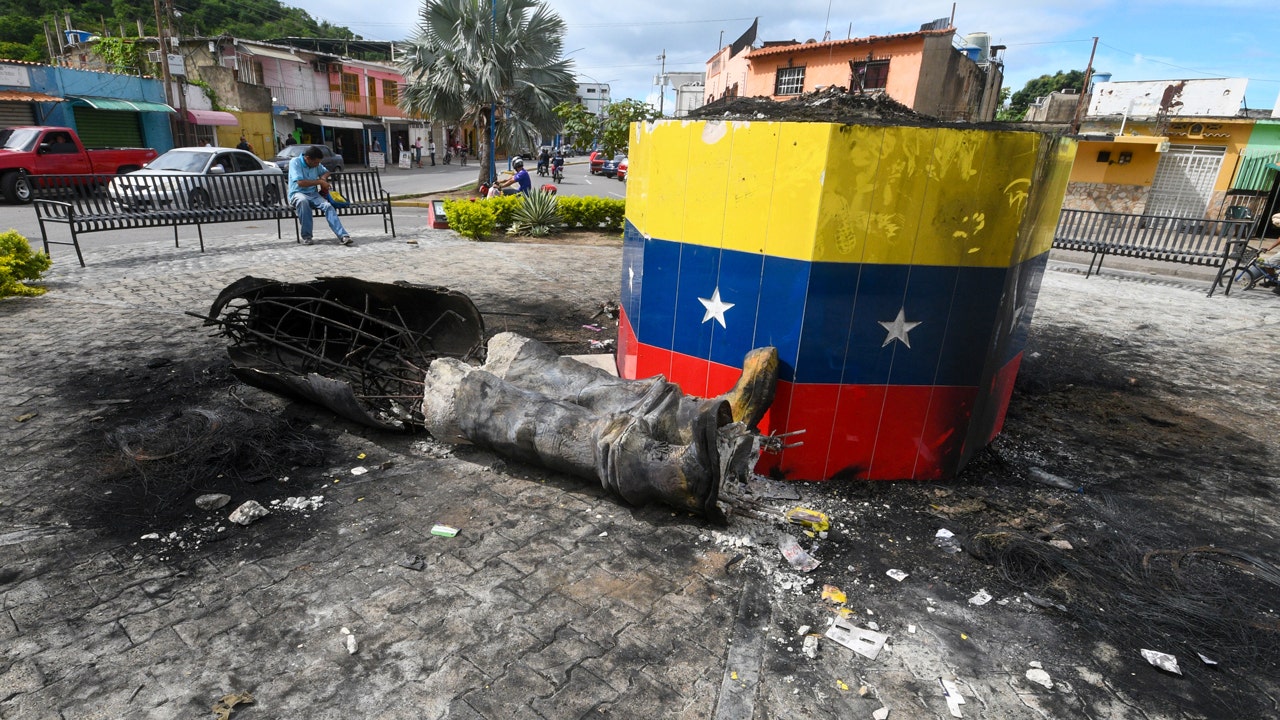
Anti-government activists in Venezuela are expressing their anger over the alleged stealing of an election by toppling statues of former President Hugo Chávez, who was succeeded by Nicolás Maduro. In La Guaira, a 12-foot statue of Chávez was pulled down by protesters, doused in gasoline, and set on fire. This act is seen as a powerful symbol of opposition by the protesters, who feel that by removing statues of Chávez, they are weakening the government’s strength. This attack on Chávez’s statues is not a new phenomenon, as similar incidents occurred during previous waves of anti-government unrest in 2017 and 2019.
The recent attacks on Chávez’s statues, with five incidents occurring in the last 24 hours, highlight the depth of anger among many Venezuelans following the National Electoral Council’s declaration of Maduro as the winner of the presidential election. The opposition claims that their candidate, Edmundo Gonzalez, received more than double the votes of the incumbent Maduro. Despite this, Maduro continues to hold onto power, leading to increased frustration and protests among the population. Security forces in Venezuela have been cracking down on protesters, and several individuals have been arrested in connection with the attacks on the statues.
Maduro has condemned the attacks on the statues, likening them to images from revolutions orchestrated by the United States in other countries. He warned that those who seek to disrespect Chávez are offensive to the millions of Venezuelans who idolize the former president. Maduro has characterized opposition activists as dangerous revolutionaries who would cause chaos if they were to come to power. The destruction of Chávez’s statues is seen as a direct challenge to Maduro’s rule and a symbolic act of defiance against his government.
The destruction of Chávez’s statues is part of a broader resistance movement against Maduro’s government and his handling of the country’s economic and political crisis. The opposition in Venezuela sees the destruction of the statues as a way to diminish the cult of personality surrounding Chávez and to challenge the legitimacy of Maduro’s rule. By attacking symbols associated with the ruling party, the protesters aim to weaken the government’s grip on power and to send a clear message of dissent. The vandalism of Chávez’s statues reflects the growing discontent and frustration among the Venezuelan population.
The ongoing political crisis in Venezuela has deepened as Maduro clings to power despite widespread allegations of election fraud and economic mismanagement. Anti-government activists are using the destruction of Chávez’s statues as a form of protest against what they view as an illegitimate regime. The attacks on the statues are a visible expression of opposition to Maduro’s rule and a symbol of resistance to his government. The destruction of Chávez’s image is a way for protesters to assert their defiance and to challenge the authority of the ruling regime. The repercussions of these protests and acts of defiance remain to be seen as tensions escalate in Venezuela.