



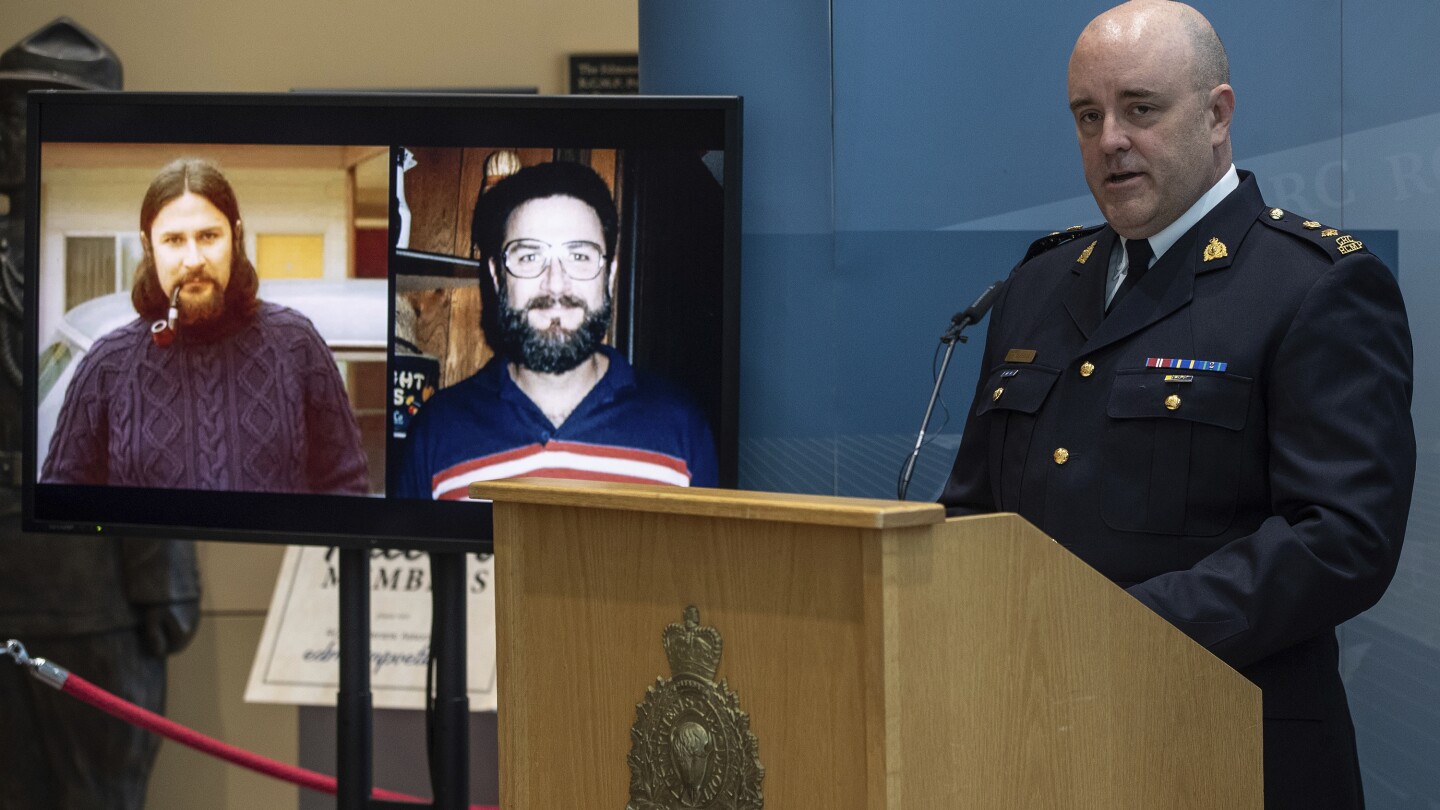
Canadian police have recently announced that they have linked the deaths of four young women nearly 50 years ago to a now-deceased U.S. fugitive who hid in Canada from the mid-1970s to the late 1990s. Gary Allen Srery, who died in 2011 while serving a life sentence for sexual assault in a state prison in Idaho, is believed to be connected to these unsolved murders. Authorities are now reaching out to the public for more information that may link Srery to other unsolved cases. The breakthrough in these cold cases came when authorities compared DNA of the killer with profiles on ancestry websites, eventually leading them to a match with Srery.
Details of the four Canadian cases linked to Srery were provided by Alberta Royal Canadian Mounted Police Supt. Dave Hall. In 1976, Eva Dvorak and Patricia McQueen, both 14-year-olds living in Calgary, Alberta, were found dead under a highway underpass. Melissa Rehorek, a 20-year-old housekeeper living at the YMCA in downtown Calgary, was found dead in a ditch in a township west of the city. In 1977, Barbara MacLean, a 19-year-old bank employee, was found dead just outside Calgary. Authorities at the time were not able to determine the cause of death for the two 14-year-olds, but Rehorek and MacLean’s deaths were attributed to strangulation. Semen was collected from all four crime scenes, but technology did not exist at that time to find DNA matches.
Srery had an extensive criminal record, including forcible rape, kidnapping, and burglary when he fled to Canada from California in 1974. He lived in Canada illegally until his arrest for sexual assault in 1998 in New Westminster, British Columbia. During his time in Canada, Srery used nine different aliases, frequently changed his appearance, residence, and vehicles, and obtained illegal identification and social assistance through aliases. He worked as a cook in Calgary from 1974 to 1979 and then in the area of Vancouver from 1979 until his arrest in 1998. Following deportation to the U.S. in 2003, Srery was convicted in Idaho for sexually motivated crimes and sentenced to life in prison.
Alberta RCMP Insp. Breanne Brown stated that Srery’s criminal activities spanned decades and multiple jurisdictions under various aliases. Authorities believe there could be more victims connected to Srery, and they are seeking the public’s help in furthering his timeline in Canada. Despite Srery’s death in 2011, the investigation into his potential involvement in other unsolved cases continues. The use of DNA technology and public cooperation have been crucial in making these connections and seeking justice for the victims and their families.
The announcement of these cold case breakthroughs sheds light on the extensive criminal history of Gary Allen Srery and his time in Canada as a fugitive. The victims, Eva Dvorak, Patricia McQueen, Melissa Rehorek, and Barbara MacLean, finally have some closure as their cases are linked to a known offender. The collaborative efforts of law enforcement agencies in Canada and the U.S., along with advancements in DNA technology, have played a significant role in solving these decades-old mysteries. The call for public assistance underscores the importance of community involvement in bringing justice to victims of violent crimes and ensuring that perpetrators are held accountable for their actions.